Introduction to Density of Liquids
Learning Outcomes
- Apply the safety rules in the chemistry laboratory through proper and safe handling of chemicals and chemical equipment.
- Identify and use common equipment and measuring devices in the chemistry laboratory.
- Properly record experimental data including the precision appropriate to the measuring devices used.
- Properly make measurements of length, mass, volume, and temperature.
- Properly perform the technique of filtration, quantitative transfer of materials, pipetting and use of the Bunsen burner.
- Determine the density of liquids.
- Collaborate in class data analysis by contributing individual results and calculating class averages and standard deviations.
Density is calculated using the formula:
For liquids, mass is measured in grams (g) and volume in milliliters (mL), giving density units of grams per milliliter (g/mL). To determine the density of a liquid, you need to measure both its mass and volume using laboratory tools. The mass is found with an analytical balance, which is sensitive enough to detect changes as small as a thousandth of a gram. The volume is measured using a graduated cylinder, which allows you to estimate to the nearest tenth of a milliliter.
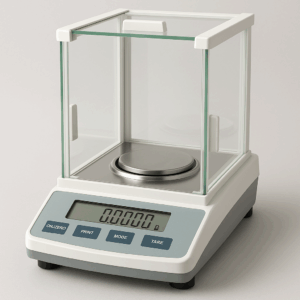
Using an analytical balance correctly is key to getting accurate mass measurements. First, make sure the balance is on a level surface and that its doors are closed when in use to prevent air currents from affecting the reading. Turn on the balance and let it zero by pressing the “tare” or “zero” button (it should read 0.000 g). Place a clean, dry graduated cylinder or beaker on the center of the weighing pan and close the doors and record the displayed mass. Carefully remove the graduated cylinder & pour in the liquid to the desired volume. Place the graduated cylinder back on the balance, close the doors again, and record the displayed mass. Be sure to handle the container with a paper towel or gloves to avoid adding mass with fingerprints or moisture. Because you can’t weigh a liquid directly, you find its mass by a simple subtraction method. The mass of the liquid alone is the difference between the graduated cylinder and liquid and the graduated cylinder alone.
Understanding the reliability of your measurements involve two key ideas: accuracy and precision. You will use both accuracy and precision to evaluate your experimental data.
Remember:
To find the percent error, use the following formula:
For example, if your measured density of ethanol is 0.800 g/mL and the accepted value is 0.789 g/mL, your percent error would be:
This tells you how far off your result was from the actual value.
Remember, precision is evaluated using standard deviation. To find the standard deviation, use the following formula:
For example, let’s say your three measured densities for an unknown liquid are:
-
Trial 1: 0.790 g/mL
-
Trial 2: 0.786 g/mL
-
Trial 3: 0.792 g/mL
- Find the average:
- Plug into the standard deviation formula:
This tells us the density values vary by about ±0.0031 g/mL, which is quite precise. A small standard deviation (usually less than 1) means your measurements were consistent, which reflects good experimental technique.
In this lab, you will first measure the density of water, which serves as a reliable reference point since its density at room temperature is known to be about 0.998 g/mL. After practicing with water, you will measure the density of an unknown liquid and compare your results to known values for common organic liquids. By analyzing both your percent error and standard deviation, you will not only identify the unknown but also reflect on the quality of your measurements—just like scientists do in real research labs.