Introduction to Molecular Modeling

Learning Objectives

  • Use the chemical formula to draw the Lewis Structure for a compound and predict the molecular geometry.
  • Apply the safety rules in the chemistry laboratory through proper and safe handling of chemicals and chemical equipment.

We will focus on molecules and polyatomic ions that have single, double, or triple bonds and one central atom, which is the atom bonded to all the others. The main goal is to practice drawing Lewis structures—two-dimensional diagrams that show bonding and lone pairs of electrons—predicting electron geometry, which describes the arrangement of regions of electron density around the central atom, and predicting the molecular shape, which is the actual arrangement of atoms in space. You will also estimate bond angles; the angles formed between bonds originating from the same atom.

To accomplish this, we use the VSEPR Theory (Valence Shell Electron Pair Repulsion Theory), which states that electron regions repel each other and arrange themselves as far apart as possible. Key concepts include understanding a Lewis structure, which shows all the valence electrons in a molecule or ion; electron geometry, which considers both bonds and lone pairs; molecular shape, which focuses only on the atoms; and bond angles, which describe the spacing between bonds. Knowing molecular shape is critical because it directly impacts chemical behavior. For example, water’s bent shape makes it polar, giving it its remarkable ability to dissolve many substances, while carbon dioxide’s linear shape makes it nonpolar despite having polar bonds. Even biological processes like enzyme function rely on molecules fitting together with precise shapes, much like puzzle pieces. Whether in chemistry, medicine, engineering, or even cooking, understanding molecular structure is key, because shape controls function.

Let’s practice building a model with a simple molecule: CO2 (carbon dioxide). We must first draw the appropriate Lewis structure to model.

Step 1: Find the total number of valence electrons.

  • The carbon atom contributes 4 valence electrons and each oxygen atom contributes 6 valence electrons to the overall structure. Therefore, this structure contains a total of 16 valence electrons available for bonding:   4 + (6×2) = 16 electrons.

Step 2: Arrange the skeletal structure of the molecule.

  • Less electronegative atoms are central & more electronegative atoms are placed terminally. In this molecule, the carbon (C) atom will be in the center because it is less electronegative than oxygen.

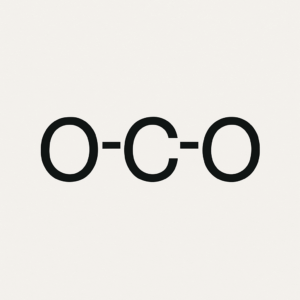
  • Arrange the two oxygen (O) atoms on each side of the carbon atom. While more electronegative atoms are always placed terminally, we must also consider symmetry when building these molecules. Placing one oxygen atom on each side of the carbon allows the oxygen atoms to be both terminal and for the molecule to be most symmetrical in this setup, which allows for a more energetically favorable molecule.

This is the second step in drawing a Lewis structure. The carbon atom is placed in the middle and one oxygen atom is placed on each side of the carbon atom.
Image generated by OpenAI’s DALL·E.

Step 3: Connect atoms with single bonds.

  • Single bonds should be placed between the central atom & each terminal atom. Account for the number of additional electrons used through the distribution of single bonds.
  • 16 valence electrons – 4 electrons (2 single bonds) = 12 valence electrons remaining
This is the third step in drawing a Lewis structure. The carbon atom is placed in the middle and one oxygen atom is placed on each side of the carbon atom and single bonds connecting the carbon to each oxygen atom.
Image generated by OpenAI’s DALL·E.

Step 4: Distribute the remaining electrons on the outer atoms.

  • All remaining electrons should be distributed on the outer atoms first to make octets on each outer atom until all electrons have been exhausted. If electrons are remaining after each outer atom has an octet, leftover electrons may be dispersed on the central atom.

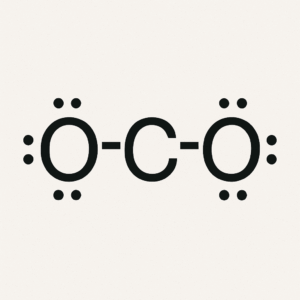
  • For carbon dioxide shown below:

16 valence electrons – 4 electrons (2 single bonds) -12 electrons (distributed in pairs on the oxygen atoms) = 0 remaining electrons

The carbon atom is placed in the middle and one oxygen atom is placed on each side of the carbon atom. All remaining electrons are placed in pairs around the oxygen with each oxygen containing an octet of electrons.
Image generated by OpenAI’s DALL·E.

Step 5. Evaluate your structure for stability.

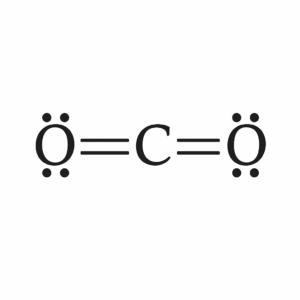
In the above structure, each oxygen atom has an octet (3 lone pairs & 1 bonded pair), but the carbon atom does not have a full octet. To ensure that carbon has a full octet, form double bonds with each oxygen and reevaluate the stability.

This is the stable Lewis structure of carbon dioxide that contains two double bonds and two lone pairs around each oxygen.
Image generated by OpenAI’s DALL·E.

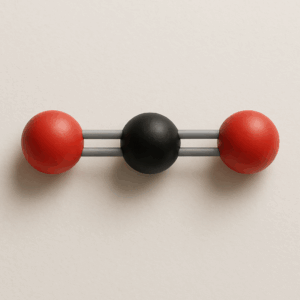
Once you have drawn the correct Lewis structure, you can build your model! Based on the Lewis structure above, the corresponding ball & stick model for carbon dioxide would look like:

Ball and stick model of carbon dioxide.
Image generated by OpenAI’s DALL·E.

Now we are able to determine other characteristics of the molecule including bonding angle, electron pair geometry, and molecular shape using the quick reference chart below.

Quick reference chart

# of Domains # of Lone Pairs Electron Geometry Molecular Shape Approximate Bond Angles
1 0 Linear Linear 180°
2 0 Linear Linear 180°
3 0 Trigonal Planar Trigonal Planar 120°
3 1 Trigonal Planar Bent <120°
3 2 Trigonal Planar Linear <120°
4 0 Tetrahedral Tetrahedral 109.5°
4 1 Tetrahedral Trigonal Pyramidal <109.5°
4 2 Tetrahedral Bent <109.5°
4 3 Tetrahedral Linear <109.5°

Using the quick reference chart above and the molecular structure of carbon dioxide, the molecular shape is linear with a 180° bond angle.

License

Icon for the Creative Commons Attribution-NonCommercial 4.0 International License

Introductory Chemistry Lab Manual by The authors & Hillsborough College is licensed under a Creative Commons Attribution-NonCommercial 4.0 International License, except where otherwise noted.

Share This Book