Laboratory Preparation & Procedure
Materials:
- Solid Potassium Hydrogen Phthalate (KHP)
- Sodium hydroxide solution (unknown concentration)
- deionized water
- phenolphthalein indicator
- burette
- burette clamp
- ring stand
- stir plate
- magnetic stir bar
- 250 mL Erlenmeyer flask
- 100 mL beaker
- funnel
- analytical balance
- weigh tray
Safety:
NaOH is corrosive. Wear gloves at all times.
Procedure:
Clean and dry a weighing boat.
2. Place the container on the analytical balance and tare (zero) it.
3. Accurately weigh between 0.6 to 0.8 g of solid KHP. Record each exact mass as shown on the balance.
4. Transfer the KHP sample into a 250-mL Erlenmeyer flask.
5. Add about 25–50 mL of deionized water to the flask. Add a magnetic stir bar and swirl on the stir plate until the KHP is fully dissolved.
6. Add 2–3 drops of phenolphthalein indicator to the flask.
7. Setup your burette, ring stand, and stir plate as shown in the figure below. Secure the burette vertically to a ring stand using a burette clamp.
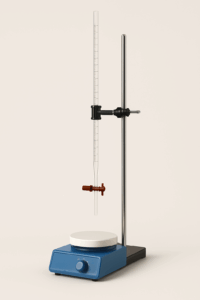
8. Using a funnel, rinse the burette with 10-mL deionized water. Discard the rinse into a waste beaker.
9. Condition your burette by running 5 mL of the NaOH solution through the burette Discard the rinse into a waste beaker.
10. Rinse the burette a second time with a fresh sample of 5 mL of the NaOH solution. Discard the rinse into a waste beaker.
11. Close the stopcock & use a funnel to fill the burette with the NaOH solution to just above the 0.00 mL mark.
12. Remove the funnel after filling to prevent additional drops from entering.
13. Open the stopcock briefly to remove air bubbles from the tip and bring the level down to just at or below 0.00 mL.
14. Record the initial volume of NaOH to the correct precision of the instrument.
15. Place the Erlenmeyer flask containing the dissolved KHP under the burette on a white background (like paper) to help detect the endpoint color change.
16. Slowly add NaOH while gently swirling the flask with your other hand.
17. As the pink color begins to persist faintly, reduce the flow rate to dropwise.
18. Stop adding NaOH when the pale pink color remains for at least 30 seconds. This is the endpoint of the titration. A dark pink color indicates you have over titrated your sample and have passed the endpoint.
19. Record the final volume of NaOH from the burette to the correct precision of the instrument.
20. Repeat steps 15–19 for at least two additional KHP samples, ensuring consistent swirling and endpoint detection.
21. Rinse all glassware with deionized water.
22. Dispose of waste solutions as directed by your instructor.