
Chapter VI: Cell Structure and Function
Learning Objectives
Course Objective for this section: Discuss and apply biological theories and concepts of the cellular basis of life, including cell structure and function and the metabolic processes that affect cells.
- Describe the structure and function of cellular structures contained in prokaryotic and eukaryotic cells.
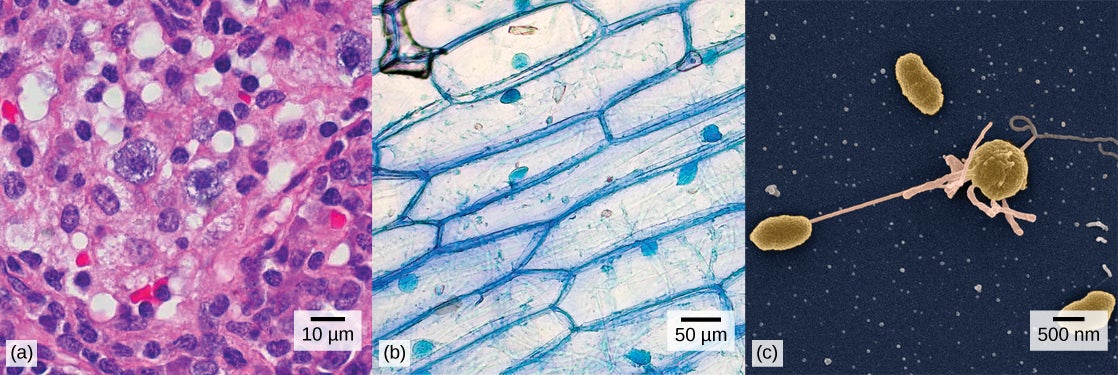
Close your eyes and picture a brick wall. What is the basic building block of that wall? It is a single brick, of course. Like a brick wall, your body is composed of basic building blocks, and the building blocks of your body are cells (Figure 1a-c).
Your body has many kinds of cells, each specialized for a specific purpose. Just as a home is made from a variety of building materials, the human body is constructed from many cell types. For example, epithelial cells protect the surface of the body and cover the organs and body cavities within. Bone cells help to support and protect the body. Cells of the immune system fight invading bacteria. Additionally, red blood cells carry oxygen throughout the body. Each of these cell types plays a vital role during the growth, development, and day-to-day maintenance of the body. In spite of their enormous variety, however, all cells share certain fundamental characteristics.
Chapter VI: Cell Structure and Function
Licenses and Attribution
CC Licensed Content, Original:
This educational material includes AI-generated content from ChatGPT by OpenAI. The original content created by Dr. Zeinab Motawe from Hillsborough College is licensed under a Creative Commons Attribution-NonCommercial 4.0 International License (CC BY-NC 4.0).
All images in this textbook generated with DALL-E are licensed under the terms provided by OpenAI, allowing for their free use, modification, and distribution with appropriate attribution.
CC Licensed Content, Shared Previously:
Adapted from:
- Bartee, L., & Anderson, C. (2019). General Biology I: Survey of Cellular Biology, CC BY 4.0.